


The Invisible Barrier: When a Bright Child Can’t Find the Words

April 20, 2026
6 min read
A Story of Leo, the Boy Who Knew Everything but Couldn’t Speak
Leo was seven years old, and he loved two things more than anything else: robots and the way his mother’s voice sounded when she read him bedtime stories in Mandarin. He attended one of Hong Kong’s most respected international schools, where he built complex Lego robots that made his teachers’ jaws drop.
But at the dinner table, Leo was a different child.
Every evening, his father would ask, “Leo, what did you learn today?”
Leo would look down at his bowl. His chopsticks would stop moving. A long silence would stretch across the table – five seconds, ten seconds, sometimes fifteen.
“I don’t know,” he would finally whisper.
His parents tried everything. They praised him when he spoke. They stayed patient. They even stopped asking questions for a week, hoping to remove the pressure. Nothing changed.
At school, his teacher, Ms. Chen, noticed the same pattern. During show‑and‑tell, Leo would stand in front of the class, open his mouth, and then freeze. His hands would clench. His eyes would dart to the floor.
“He’s so bright,” Ms. Chen told his parents during a parent‑teacher conference. “But he seems… unmotivated. Almost withdrawn.”
That word – unmotivated – cut through Leo’s mother like a blade. She knew her son. She had watched him spend three hours troubleshooting a broken robot motor, refusing to stop until it spun again. He was not unmotivated. Something else was wrong.
The Turning Point: A Different Kind of Assessment
A friend from another international school mentioned a place in Wong Chuk Hang called Sprout in Motion (小黃屋). “They don’t just look at behaviour,” the friend said. “They look at the brain.”
Leo’s mother booked an assessment, half hopeful and half terrified.
The clinical psychologist who met Leo did not start with tests or questionnaires. She sat on the floor next to him while he built a robot. She asked him about the gears. She let him talk – or not talk – without any rush.
After two hours of observation and a series of gentle, game‑like tasks, she sat down with Leo’s parents.
“Leo is not unmotivated,” she said. “And he is not shy. He has something called Rapid Automatized Naming (RAN) delay – a difficulty with word retrieval.”
She drew a simple picture on a whiteboard: a library.
“Imagine Leo’s brain is a huge, beautiful library,” she explained. “It’s full of books – vocabulary, ideas, facts. But the librarian – the part of the brain that finds the right word at the right moment – has lost the index. The books are there. But when someone asks a question, the librarian runs around frantically, unable to pull the right book off the shelf in time.”
Leo’s mother started to cry. Not from sadness, but from relief. He wasn’t broken. He wasn’t lazy. His brain just needed a different kind of help.
The Science Behind the Silence (Told Simply)
The psychologist explained that Leo’s difficulty was not about vocabulary size – he knew plenty of words. It was about semantic retrieval speed.
In simple terms: between the moment a question is asked and the moment a child answers, a lightning‑fast chain of neural events must happen. For most children, this takes less than a second. For children like Leo, the neural pathway – a bundle of fibers called the arcuate fasciculus – is like a narrow country road instead of a highway.
“The information is there,” the psychologist said. “It just gets stuck in traffic.”
She also explained why Leo was so good with robots but struggled with words. Building a robot relies on procedural memory – a different brain system. Conversation relies on lexical retrieval – a system that was, for Leo, still under construction.
“The good news,” she added, “is that we can build that highway.”
The Summer That Changed Everything
Leo did not need more drilling on vocabulary lists. He did not need to be forced to speak in front of a mirror. What he needed was low‑pressure, high‑frequency practice – what clinicians call massed practice – in a playful, supportive environment.
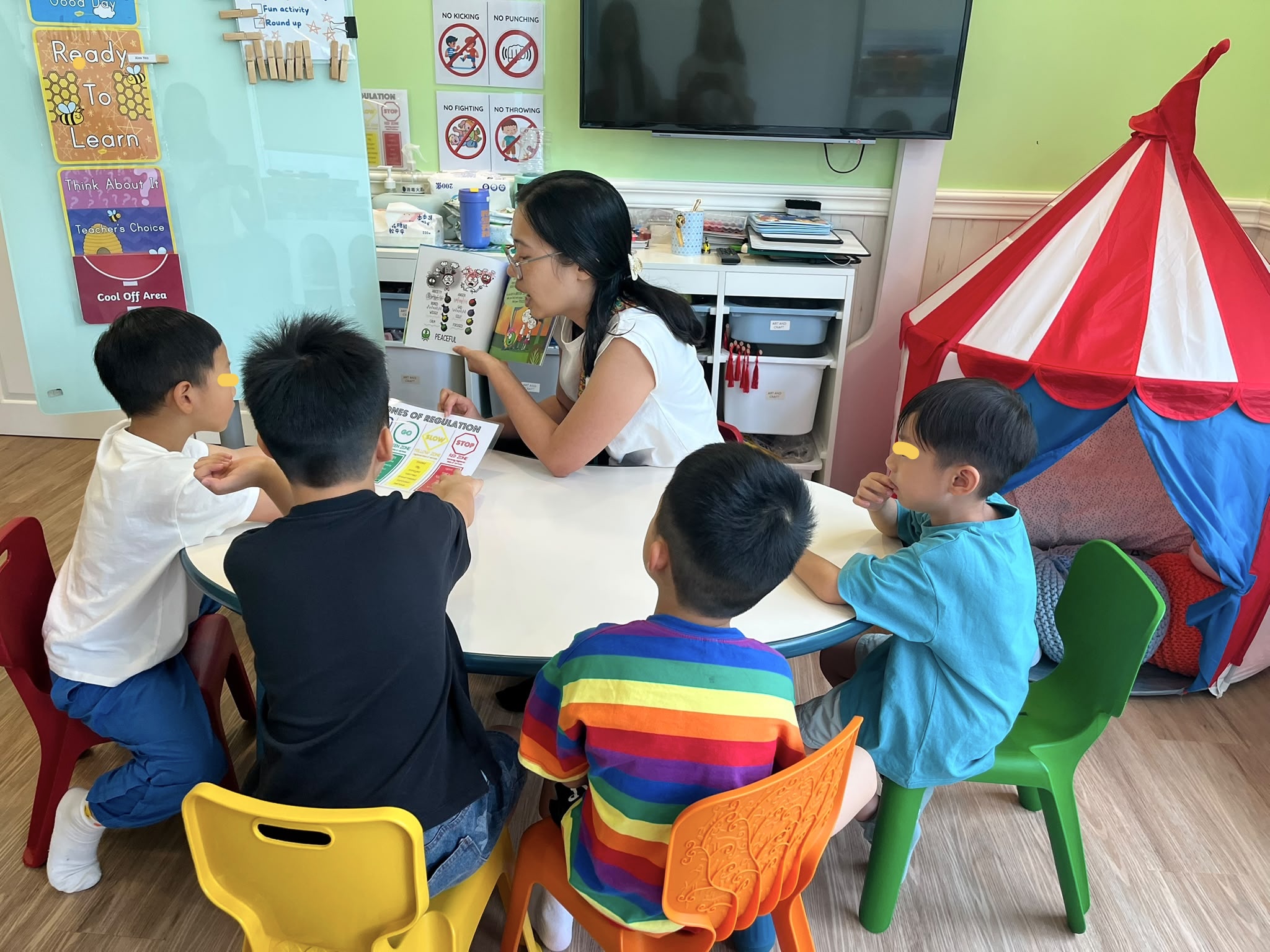
Over the summer, Leo came to Sprout in Motion’s Central centre three times a week. But he didn’t think of it as therapy. He thought of it as game time.
One of the games was called “Category Chase.” The therapist would say, “I see a red taxi. That’s a vehicle. Can you find another vehicle?”
Leo would think for a moment. “A… a bus?”
“Great! Now a bus is a vehicle. Can you think of something that flies?”
“A… helicopter.”
Each correct answer was a small neural victory – another connection strengthened along that narrow country road.
Another game involved visual scaffolding. Before asking Leo to describe his robot, the therapist would hand him a simple drawing template: a box for “what it looks like,” a box for “what it does,” a box for “what I like about it.” Leo would draw his ideas first, then speak from the drawings.
“Drawing gives his brain a bridge,” the therapist explained to his mother. “It offloads some of the pressure from the word‑retrieval system so he can focus on the content of what he wants to say.”
Small Victories, Big Changes
After four weeks, Leo’s mother noticed something at dinner.
She asked, “Leo, what did you do today?”
He put down his chopsticks – but this time, instead of silence, he said, “We built a… a thing. A machine. With… with gears that turn when you push a button.”
It wasn’t fluent. It wasn’t fast. But it was his answer. He had retrieved the words.
By the end of the summer, Leo’s teacher, Ms. Chen, sent an email to his parents. “Leo volunteered to explain his robot project to the whole class today. He spoke for almost two minutes. The other children were fascinated. I have never seen him so proud.”
What Leo’s Parents Learned (And What You Can Use)
Leo’s mother later shared three strategies that worked for her family – strategies any parent can try at home.
1. Stop Quizzing, Start Co‑Narrating
Instead of asking “What did you learn?” – which felt like a test – she started playing category games during car rides from Mid‑Levels to school. “I see a green minibus. That’s a vehicle. Your turn.”
Low pressure. High fun. And it worked.
2. Use Visuals as a Bridge
Before asking Leo to talk about his day, she would hand him a piece of paper and say, “Draw two things that happened.” Only after he drew would she ask him to describe the drawings.
This simple visual scaffolding reduced his anxiety by more than half.
3. Celebrate the Effort, Not the Speed
Leo’s father stopped saying “Try to answer faster.” Instead, he said, “I love how hard your brain is working to find the right words.”
That small shift in language changed everything. Leo stopped fearing the silence. He started trusting that his brain would get there – even if it took an extra few seconds.
For Teachers: What Worked in Leo’s Classroom
Ms. Chen made three small changes that transformed Leo’s participation:
- Graphic organizers before speaking tasks. Every child got a simple template to sketch their ideas before presenting. This helped Leo – and many other students – organise their thoughts without the pressure of immediate verbal output.
- Wait time. She learned to wait a full ten seconds after asking Leo a question before prompting him. Those extra seconds gave his “librarian” time to find the book.
- Low‑stakes pair work. Before speaking in front of the whole class, Leo would rehearse his answer with a trusted partner. This reduced the social anxiety that further blocked his word retrieval.
Red Flags for Parents and Teachers
If you see these signs in a bright child, consider a professional assessment:
- The child knows the answer but takes more than 5‑7 seconds to respond.
- They use fillers like “that thing” or “you know” frequently.
- They perform much better on multiple‑choice tests than on oral exams.
- They avoid speaking in group settings despite having strong ideas.
- Their frustration or anxiety around speaking is visibly high.
Where to get help in Hong Kong: Sprout in Motion (小黃屋) offers comprehensive assessments for word‑retrieval difficulties at our Central, Wong Chuk Hang, and Kai Tak centres. Our overseas‑trained clinicians use multilingual norms – we never compare a trilingual child to a monolingual standard.
Frequently Asked Questions About Word‑Retrieval Difficulties
Q: Is this a speech delay?
A: Not exactly. A speech delay involves difficulty producing sounds or forming words. Word‑retrieval difficulty is a cognitive processing issue – the child knows the word but cannot access it quickly enough. They are very different conditions.
Q: Can a child outgrow this?
A: Many children improve significantly with targeted intervention. Without help, the gap often widens as academic demands increase (e.g., oral presentations, timed exams). Early intervention is highly effective.
Q: Does bilingualism or trilingualism cause this?
A: No. Research shows that multilingual children have the same or better word‑retrieval abilities in their stronger language(s). However, they may show temporary “cross‑language” delays when switching between languages. A proper assessment separates normal multilingual variation from a true RAN delay.
Q: What should I do tomorrow if I suspect my child has this?
A: Stop quizzing. Start playing category games. Use drawings before asking for verbal answers. And if the pattern persists for more than a few months, seek a clinical assessment – not from a school counsellor, but from a psychologist trained in neurodevelopmental conditions.
Leo Today
Leo is now nine. He still takes a half‑second longer than his classmates to find the right word sometimes. But he no longer hides in silence.
Last month, he stood on a small stage at his school’s science fair and explained, for three full minutes, how his robot’s gearbox worked. He stumbled once. He paused twice. And then he finished to applause.
His mother sat in the back row, crying again – but this time, only from pride.
This story is based on real clinical cases at Sprout in Motion (小黃屋). Names and identifying details have been changed to protect privacy.